Activity books remain popular for a simple reason: when they are done well, they give children a practical way to learn by doing. A child is not only watching, listening, or being told what to do. They are tracing a line, solving a maze, noticing a clue, retelling a story, choosing colors, or completing a sequence. That active participation makes the experience easier to remember and often more enjoyable than purely passive entertainment.
The benefits of activity books for children are broad, but they are especially valuable in the preschool and early elementary years. This is a period when attention span, fine motor skill, early literacy, and emotional confidence are all still developing. A good activity book offers low-pressure opportunities to practice these skills in short bursts. That matters because children at this age often learn best through repetition hidden inside play.
Why activity books still matter in a digital world
Parents today are not just comparing books against other books. They are comparing books against screens, apps, videos, and games that compete aggressively for attention. A well-designed activity book gives families something many digital options do not: tactile focus. Children turn the page, point, trace, color, and make choices at their own pace. That physical engagement can feel calmer, more grounded, and easier to fit into routines like morning quiet time, travel, or bedtime wind-down.
Core benefits activity books can support
- Fine motor development through tracing, coloring, and controlled movement.
- Attention and persistence through mazes, matching, and page-based problem solving.
- Language growth when adults talk about what the child notices or predicts.
- Confidence from completing short tasks with visible progress.
- Screen-free engagement that still feels fun and stimulating.
- Routine-building because books are easy to reuse in the same part of the day.
Cognitive and language gains happen together
One reason activity books are effective is that they rarely build only one skill at a time. A simple page can ask a child to notice patterns, follow a direction, describe what they see, and stay focused long enough to finish. When adults participate, the value increases further. A parent who asks, 'What do you think happens next?' or 'Why did you choose that path?' is turning the page into a language exercise, a reasoning exercise, and a confidence-building moment at the same time.
Story-based activity books can be even stronger here. When a child is helping a character solve a problem or move through an adventure, the activity has context. That context supports comprehension and memory. Instead of practicing in isolation, the child is connecting actions with meaning. This is part of what makes story-led books more engaging than repetitive drill formats for many families.
Fine motor practice and confidence building
Parents often think about activity books only in academic terms, but there is also a strong confidence component. Many children enjoy activity pages because the challenge feels manageable. A maze can be finished. A tracing line can be completed. A page can be colored in a way that feels uniquely theirs. These small wins matter. They help children experience effort and completion without the pressure that can come from formal schoolwork.
For younger children, the physical act of using a crayon or pencil is valuable on its own. Controlled strokes, shape repetition, and page navigation all contribute to early hand strength and coordination. Those are not glamorous outcomes, but they are foundational ones. The right activity book makes that practice feel enjoyable instead of forced.
Choosing books with lasting value
Not every activity book delivers the same benefits. Some are too repetitive. Some are too advanced. Some do not hold a child's interest beyond one sitting. Families usually get better results when they choose books with a strong theme, a variety of activity types, and pages that feel intentional rather than mass-produced filler. If the child wants to come back to the book, the value rises immediately.
- Look for variety rather than fifty versions of the same task.
- Choose books that fit your child's age and current attention span.
- Prioritize books with strong visual design and a clear emotional theme.
- Consider story-based formats if your child likes characters and repeated reading.
- Add printable extensions if your child often wants more after finishing a page.
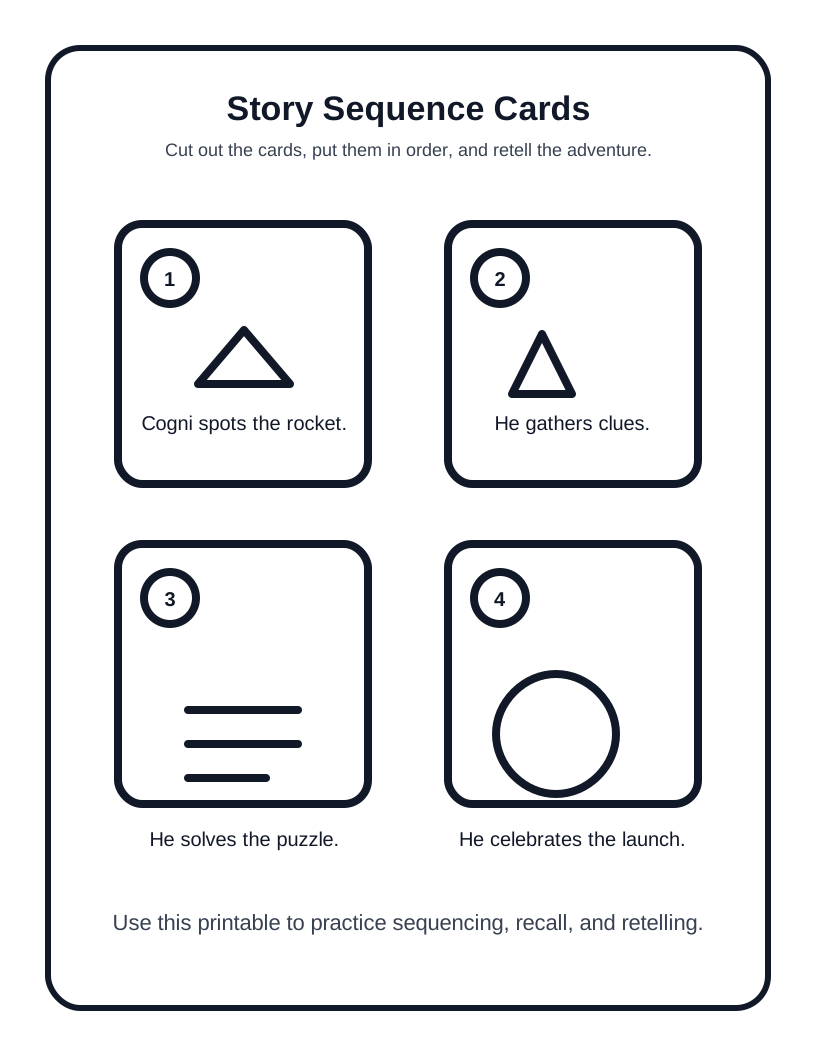
This is where Cogni's Adventures becomes relevant. It approaches the category as a children's activity book, not just a worksheet book. The story gives children context, the activity moments keep them engaged, and the printable extensions give families an easy next step when they want more without searching for unrelated content somewhere else.
Social-emotional benefits of shared activity time
Activity books are often framed around academic skills, but the social-emotional side is just as real. When an adult sits down with a child to work through a page together, the activity becomes a shared moment rather than an independent task. That shared attention supports emotional connection and gives children a low-pressure setting to talk about their day, ask questions, or express how they feel about a story.
This matters especially for children who find pure conversation harder to initiate. A page in front of them — something to point at, color, or solve together — often makes it easier to talk than sitting face to face with no shared focus. Many parents notice that some of their best conversations with a young child happen during these quiet, activity-based moments rather than during structured talks.
Frequently Asked Questions
What skills do activity books help children practice?
They often support fine motor control, attention, sequencing, early literacy, visual discrimination, and language through discussion and retelling.
Are activity books educational or just for fun?
The best ones are both. They create low-pressure practice opportunities while still feeling playful enough that children want to return to them.
Do children need different activity books as they grow?
Yes. Needs change quickly between ages 3 and 8, so it helps to choose books that match current skill level and interest rather than buying one-size-fits-all workbooks.
Can activity books help with a child's confidence, not just skills?
Yes. Completing a page from start to finish gives children a visible sense of accomplishment, and repeated small wins over time contribute meaningfully to a child's confidence and willingness to try new tasks.